Rethinking Densification in Gaussian SLAM: A Stationary Sampling Perspective
Abstract
Gaussian Splatting enables high-fidelity differentiable SLAM by representing scenes as anisotropic Gaussian primitives. Most systems rely on residual-driven densification, which couples refinement with representation growth: accuracy saturates at a moderate primitive count, yet memory grows throughout the trajectory, degrading throughput. We introduce TopoGS-SLAM, a stationary-sampling formulation that decouples refinement from capacity through coverage-triggered Gaussian initialization and bounded-topology optimization, turning mapping into a bounded-dimensional problem with stable scaling. On standard indoor benchmarks, TopoGS-SLAM matches or surpasses densification-based pipelines in localization and reconstruction accuracy while substantially improving memory scalability and throughput, showing that iterative topology mutation is not required for accurate Gaussian SLAM in bounded-area static indoor scenes with sufficient multi-view coverage.
Rendering Results
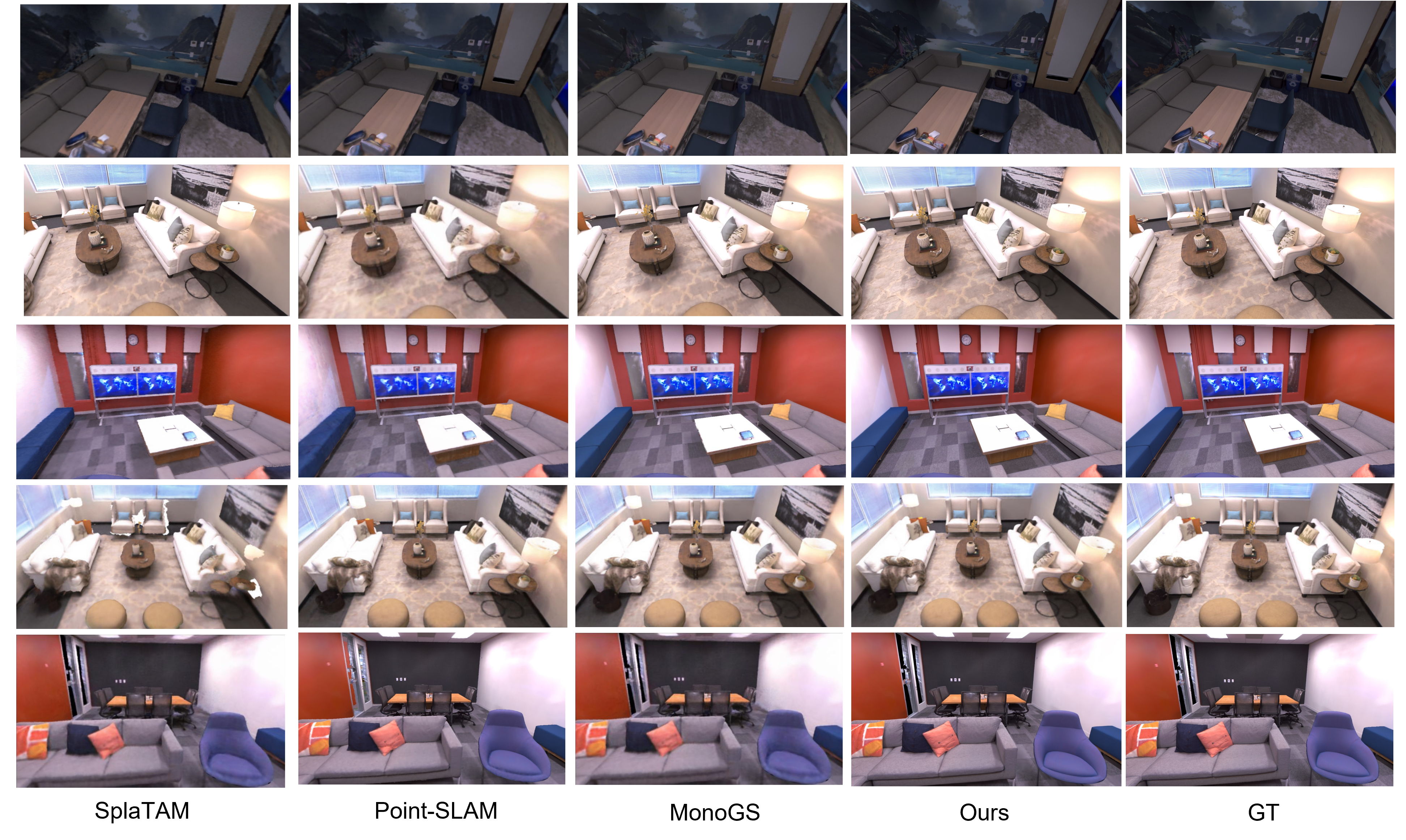
Rendering results on the Replica dataset.
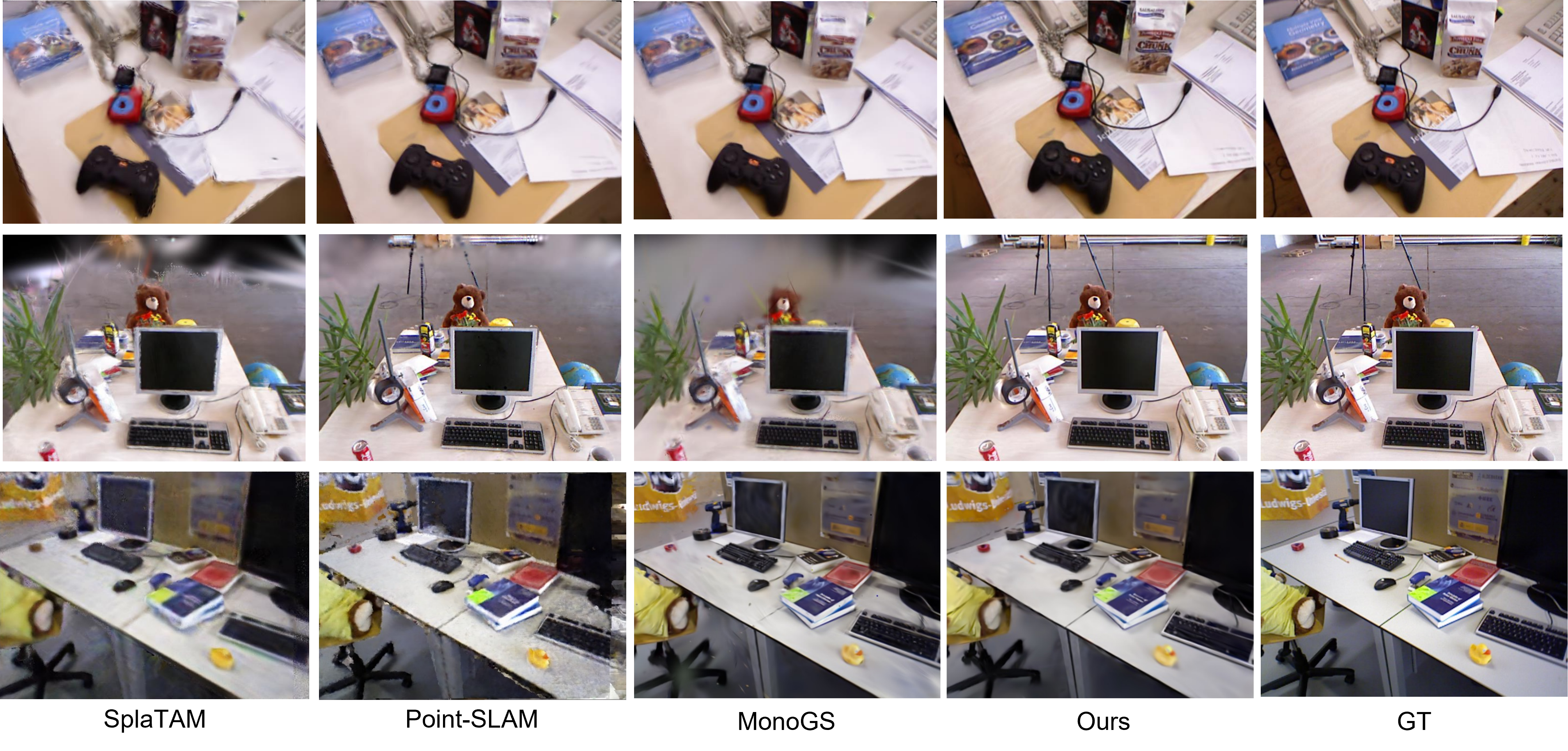
Rendering results on the TUM RGB-D dataset.
Tracking Results
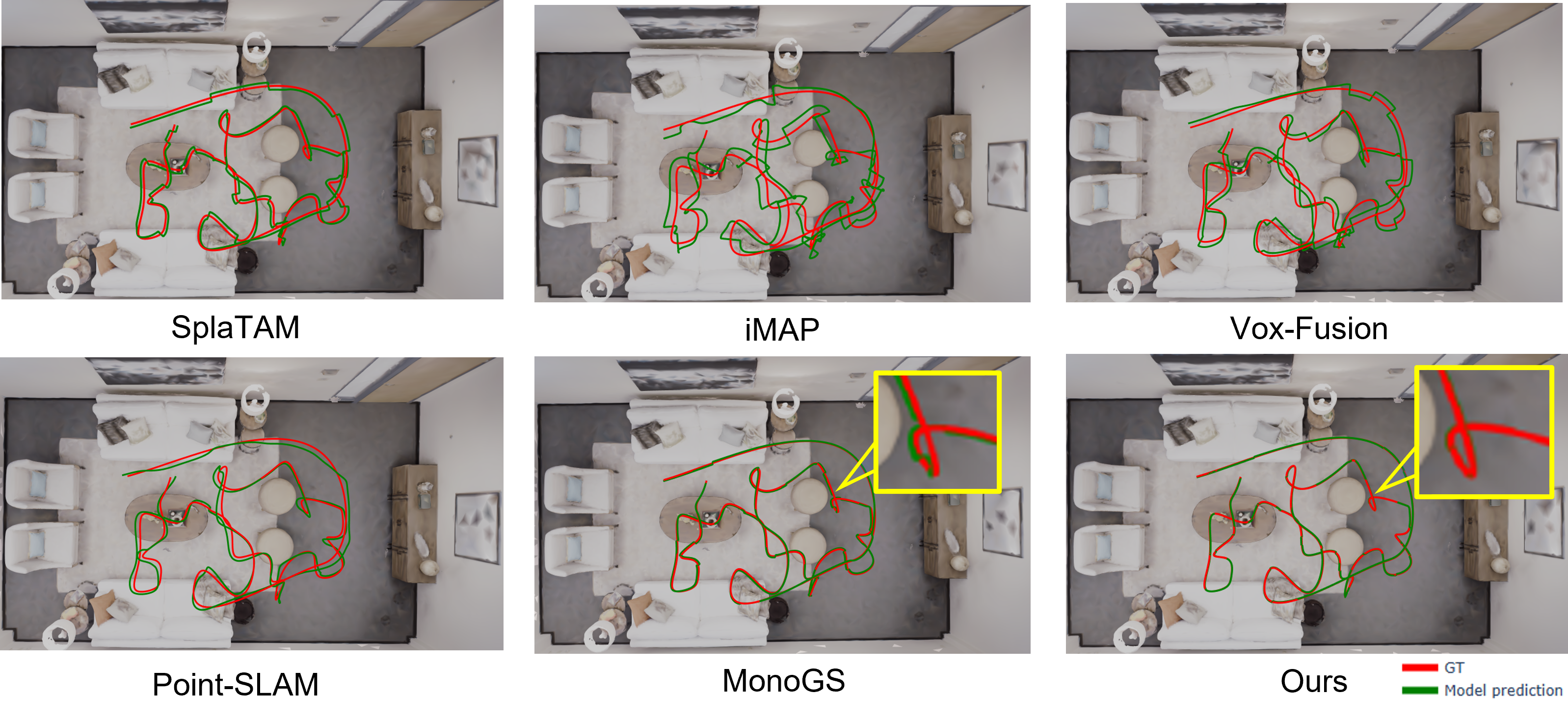
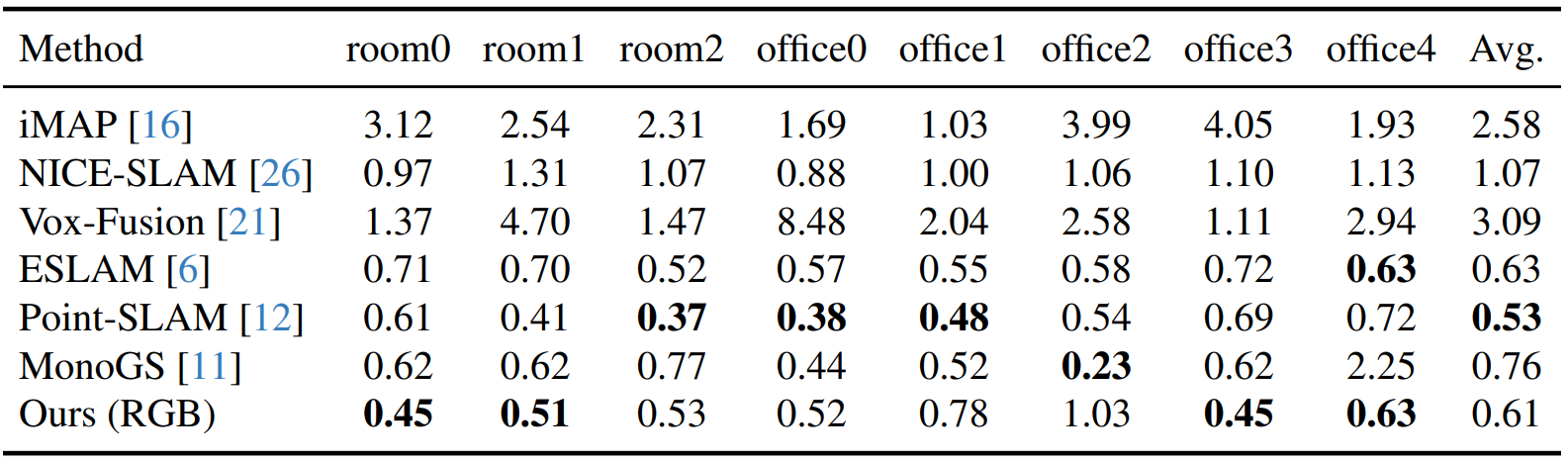
Tracking result on Replica dataset
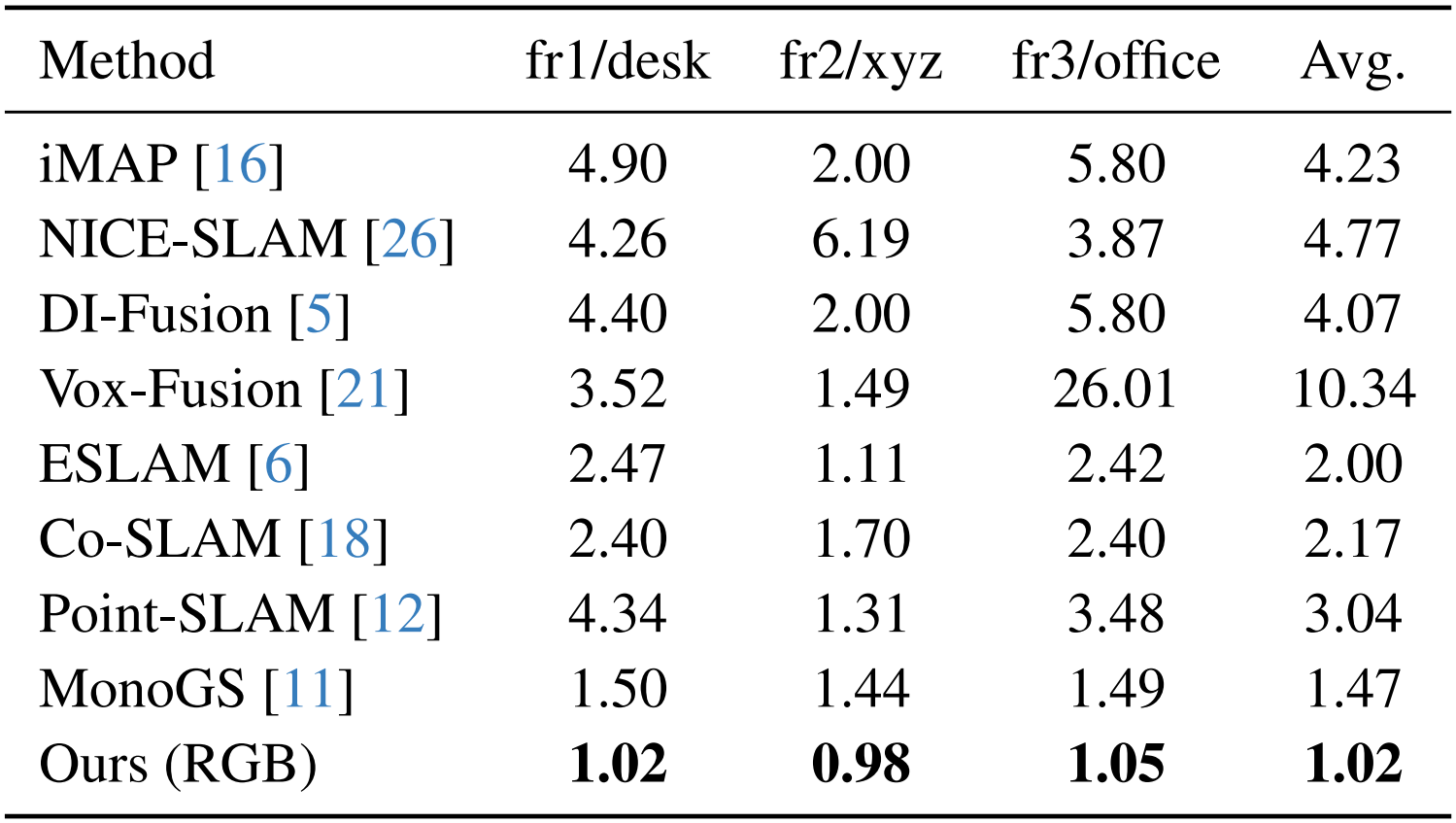
Result on Replica dataset
Result on TUM RGB-D dataset
Citation
@misc{ topogs_slam2026,
      title={Rethinking Densification in Gaussian SLAM: A Stationary Sampling Perspective},
      author={Wei-Tse Cheng, Yen-Jen Chiou, Yuan-Fu Yang},
      year={2026},
      eprint={2601.00705},
      archivePrefix={arXiv},
      primaryClass={cs.CV},
      url={https://arxiv.org/abs/2601.00705},
}